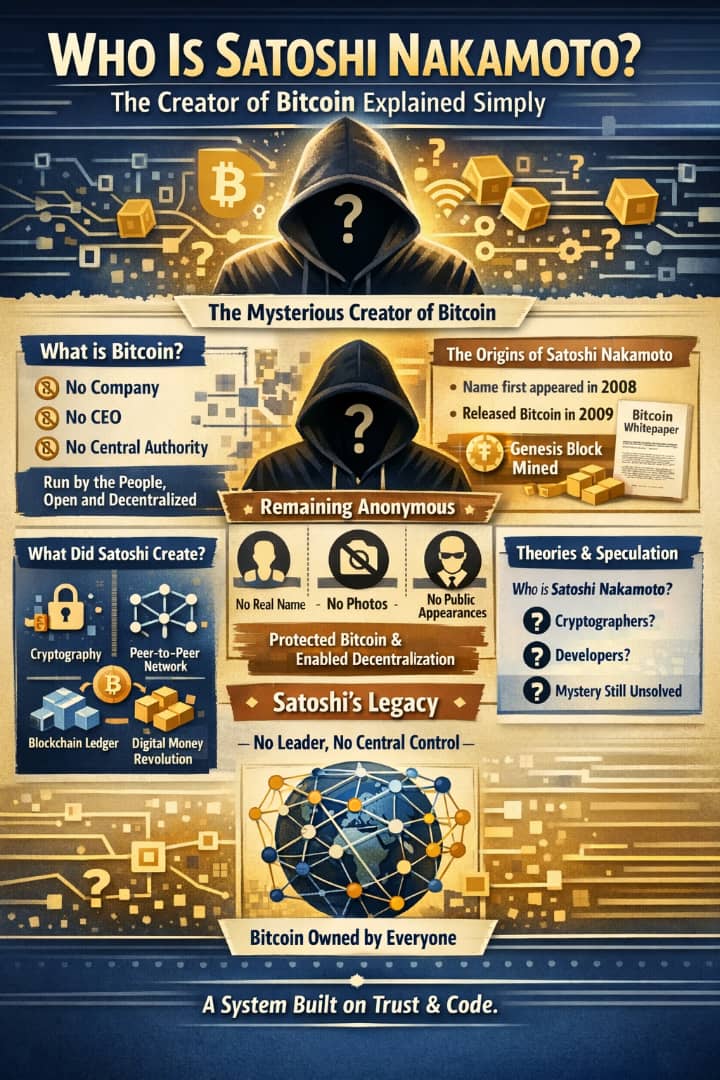
Bitcoin is the first successful decentralized digital currency.
It does not belong to a company.
It has no CEO.
It is not controlled by a government or a bank.
Instead, Bitcoin runs on open-source software and is maintained by people all over the world using blockchain technology. Anyone can inspect the code. Anyone can run a node. Anyone can participate.
At the center of this global system is a mystery that still captures attention.
Who is Satoshi Nakamoto?
Satoshi Nakamoto is the name used by the person, or group of people, who created Bitcoin. They wrote the original Bitcoin whitepaper and launched the network in 2009.
Despite creating one of the most important financial technologies of the modern era, Satoshi’s real identity has never been confirmed.
This anonymity is not accidental.
It is a core part of Bitcoin’s story.
The Origins of The Name Satoshi Nakamoto
The name Satoshi Nakamoto first appeared publicly in October 2008.
An email was sent to a cryptography mailing list. Attached was a short paper titled “Bitcoin: A Peer-to-Peer Electronic Cash System.”
The paper described a new way to send money online without relying on banks or payment processors. Instead of trust in institutions, the system relied on math, cryptography, and shared rules.
In January 2009, Satoshi released the first Bitcoin software and mined the Genesis Block, the first block in the Bitcoin blockchain.
That moment marked the beginning of the Bitcoin network.
Beyond emails, forum posts, and software updates, little else is known about Satoshi. The name itself offers no clear clues. Attempts to trace its origin through language, time zones, or writing style have led to speculation, not certainty.
And that uncertainty may be intentional.
What matters most is not who Satoshi is, but what Satoshi created.
What Satoshi Nakamoto Created
Satoshi Nakamoto did not invent every part of Bitcoin from scratch.
Instead, Bitcoin combined several existing ideas into one working system:
- Cryptographic hashing to secure data
- Peer-to-peer networks to remove central servers
- Distributed timestamps to order transactions
- Economic incentives to encourage honest behaviour
Together, these pieces formed Bitcoin.
Bitcoin allows people to send value directly to one another. Transactions are verified by the network. A public ledger records everything. No central authority is required.
This solved a major problem in digital money called double spending. Before Bitcoin, digital currencies needed a trusted company to ensure money was not copied and spent twice.
Bitcoin removed that trust requirement entirely.
This was not just a technical improvement. It changed how trust could work on the internet.
Why Satoshi Nakamoto Remained Anonymous
From the beginning, Satoshi avoided sharing personal information.
- No real name
- No photos
- No public appearances
By 2011, Satoshi stopped communicating altogether.
There are several reasons why this anonymity mattered.
First, it protected Bitcoin. If there were a known creator, that person could be pressured, threatened, or controlled. Removing a central figure made Bitcoin harder to attack.
Second, anonymity supported decentralization. Without a founder, no one has special authority. Decisions are made through discussion, code, and consensus.
Third, it matched Bitcoin’s philosophy. Bitcoin was designed to reduce reliance on trust in people. Trusting the creator would have gone against that idea.
Anonymity was not hiding.
It was part of the design.
Satoshi’s Early Involvement in Bitcoin
In the early days, Satoshi was deeply involved in Bitcoin’s development.
They wrote code.
They fixed bugs.
They answered questions.
They discussed ideas with early contributors.
Satoshi encouraged careful thinking and slow progress. Changes were debated openly. Security was always a priority.
As more developers joined, Satoshi gradually stepped back. Responsibilities were handed over. Control of the code repository was transferred.
Then communication stopped.
There was no announcement.
No explanation.
Bitcoin continued without its creator.
Theories About Satoshi Nakamoto’s Identity
Over the years, many theories have tried to uncover Satoshi’s identity.
Cryptographers.
Developers.
Academics.
Entrepreneurs.
Some people have denied being Satoshi. Others have claimed the title without proof.
In the Bitcoin community, proof matters. Without cryptographic evidence, identity claims are treated as speculation.
Bitcoin does not rely on knowing who Satoshi is.
The system works either way.
Why Satoshi’s Disappearance strengthened Bitcoin
Satoshi’s disappearance removed a central point of control.
There is no founder to appeal to.
No leader to override rules.
No authority above the protocol.
Bitcoin is governed by its participants. Changes require agreement across the network. Disagreements are resolved through discussion, testing, or, in rare cases, network splits.
This structure would be weaker if a known creator remained active.
By stepping away, Satoshi allowed Bitcoin to become truly decentralized.
Owned by no one.
Maintained by anyone.
Why Satoshi Nakamoto Still Matters Today
Satoshi Nakamoto matters because of the principles built into Bitcoin.
Those principles include:
- Reducing trust in individuals
- Making rules transparent
- Removing centralized control
Every major Bitcoin debate today connects back to these ideas.
Why Bitcoin changes slowly.
Why decentralization is protected.
Why trust is placed in code, not people.
Understanding Satoshi helps explain why Bitcoin is designed the way it is.
Conclusion
Satoshi Nakamoto is one of the most influential yet unknown figures in modern technology.
By creating Bitcoin and then stepping away, Satoshi ensured that the system would stand on its own rules rather than personal authority.
Bitcoin does not depend on knowing who Satoshi is.
It depends on code, consensus, and participation.
That may be Satoshi Nakamoto’s greatest contribution not just building Bitcoin, but leaving it behind.
About The Author