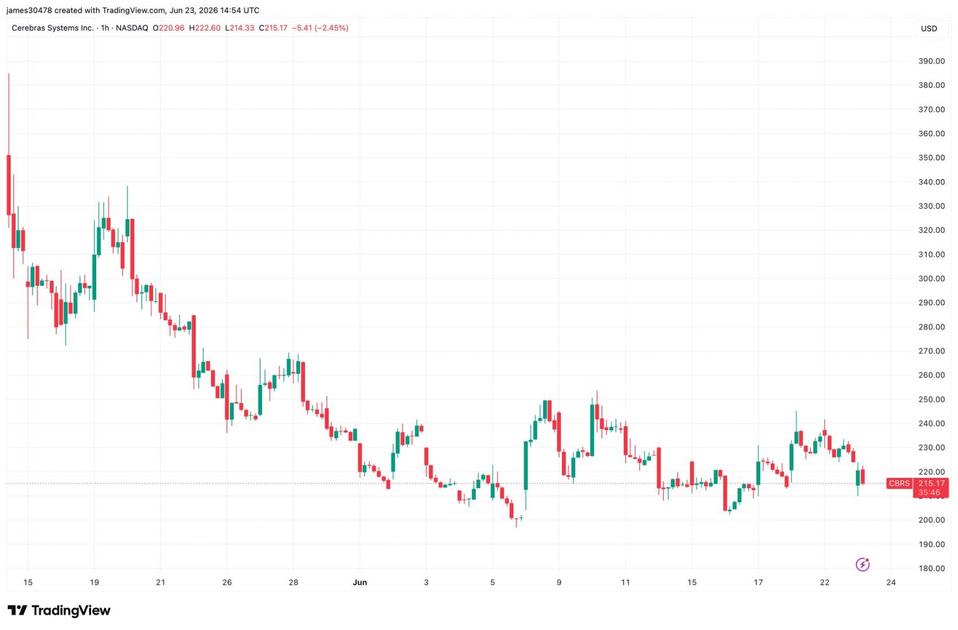
AI Chipmaker Cerebras Drops 11% After First Public Earnings Report — What It Means for the Crypto-AI Convergence
Cerebras Systems, the AI chip company that made waves with its blockbuster IPO, just delivered its first public earnings report — and the market wasn’t impressed. The stock tumbled 11% as investors digested the results, raising important questions about the intersection of AI infrastructure and the broader crypto-AI narrative that has fueled billions in token valuations. For crypto traders watching the AI sector closely, this development carries significant implications.
What Happened: Cerebras’s First Earnings as a Public Company
Cerebras, known for building the world’s largest AI chip — the Wafer-Scale Engine — reported its inaugural earnings as a publicly traded company, and the results fell short of Wall Street’s elevated expectations. The 11% sell-off reflects the growing tension between AI hype and financial reality, a dynamic that crypto markets know all too well.
The company has positioned itself as a direct competitor to Nvidia in the AI accelerator space, targeting large-scale training and inference workloads. While the technology has drawn praise from engineers and researchers, translating cutting-edge silicon into consistent revenue growth remains the core challenge. Key concerns from the earnings report included:
- Revenue concentration risk, with heavy reliance on a small number of large customers
- Elevated operating expenses as the company scales manufacturing and go-to-market operations
- Margin pressures stemming from the capital-intensive nature of custom chip production
- Forward guidance that failed to match the bullish consensus among analysts
The Crypto-AI Connection: Why This Matters for Token Markets
At first glance, a publicly traded AI chipmaker’s earnings might seem disconnected from cryptocurrency markets. But the reality is far more intertwined. Over the past two years, the crypto-AI narrative has become one of the most powerful themes driving token valuations, with projects like Render (RNDR), Fetch.ai (FET), Bittensor (TAO), and Akash Network (AKT) riding the wave of AI enthusiasm to multi-billion-dollar market capitalizations.
These decentralized AI and compute projects derive much of their speculative value from the premise that AI infrastructure demand is growing exponentially. When a company like Cerebras — which sits at the hardware layer of this ecosystem — stumbles on earnings, it introduces a reality check across the entire AI value chain. Crypto traders should pay attention to several dynamics:
- Sentiment spillover: Weakness in AI equities historically correlates with sell-offs in AI-themed crypto tokens within 24-48 hours
- Narrative fragility: The AI trade in crypto is heavily narrative-driven; cracks in the foundational thesis can trigger outsized moves
- GPU and compute economics: If hardware companies struggle with margins, it raises questions about the unit economics of decentralized compute networks
- Institutional positioning: Many institutional investors trade AI as a cross-asset theme, adjusting both equity and crypto allocations simultaneously
Broader Market Context: AI Stocks Under Pressure
Cerebras’s post-earnings decline doesn’t exist in a vacuum. The broader AI semiconductor sector has been navigating a complex environment throughout 2026, with investors increasingly demanding proof that massive capital expenditures on AI infrastructure will translate into sustainable returns. Even Nvidia, the undisputed leader in AI chips, has faced periodic bouts of volatility as the market recalibrates expectations.
For the crypto market, this creates a dual-edged dynamic. On one hand, weakness in centralized AI infrastructure companies could theoretically bolster the case for decentralized alternatives — the core thesis behind many crypto-AI projects. On the other hand, if the overall demand picture for AI compute is softer than expected, it undermines the growth assumptions baked into both traditional equities and crypto tokens alike.
It’s also worth noting that several blockchain-based AI projects have direct or indirect dependencies on hardware supply chains. Projects focused on decentralized GPU computing, for instance, ultimately rely on the same chips and infrastructure that companies like Cerebras and Nvidia produce. Any disruption or repricing at the hardware layer inevitably ripples through the decentralized compute stack.
What Crypto Traders Should Watch Next
The Cerebras earnings miss is a data point, not a death sentence for the AI narrative. However, it does signal that the market is entering a more discerning phase where fundamentals matter more than futuristic promises. For crypto traders and investors positioned in AI-themed tokens, here’s what to monitor going forward:
- Nvidia’s next earnings report: As the bellwether for AI hardware, Nvidia’s results will either confirm or deny the demand concerns raised by Cerebras
- On-chain metrics for AI tokens: Watch for changes in active users, compute utilization rates, and token velocity on platforms like Render, Akash, and Bittensor
- Correlation analysis: Track whether AI token prices continue to correlate with AI equity performance or begin to decouple
- Macro environment: Interest rate expectations and risk appetite continue to influence how aggressively capital flows into speculative AI plays across both crypto and equities
- Enterprise adoption signals: Real-world usage of decentralized AI compute — not just speculative trading volume — will ultimately determine which projects survive a narrative correction
Smart money in crypto has already started differentiating between AI tokens with genuine utility and those riding pure speculation. The Cerebras earnings report may accelerate this divergence, rewarding projects with tangible revenue and usage while punishing those built primarily on hype.
Conclusion
Cerebras’s 11% post-earnings decline is a reminder that even the most compelling technological narratives must eventually reconcile with financial reality. For the crypto market, where AI-themed tokens have captured enormous mindshare and capital, this is a moment for reflection rather than panic. The long-term convergence of AI and blockchain technology remains a powerful thesis, but the path forward will increasingly favor projects with real fundamentals over empty promises.
Now is the time to reassess your portfolio’s exposure to AI-themed crypto assets. Dig into the on-chain data, evaluate the tokenomics, and ask the hard questions about whether the projects you hold are building genuine utility or simply riding a narrative wave. The AI revolution in crypto is far from over — but the era of indiscriminate speculation may be drawing to a close. Stay informed, stay critical, and always DYOR.
Original reporting by James Van Straten via
CoinDesk
Disclaimer: This article is for informational purposes only and does not constitute financial or investment advice. Cryptocurrency investments carry significant risk. Always do your own research (DYOR) before making any investment decisions. We are not responsible for any financial losses incurred.
About The Author