Bitcoin history is the story of how digital money, blockchain technology, and decentralization came together to challenge the traditional financial system. From its early cryptographic roots to its role in today’s global economy, Bitcoin represents a new way to transfer and store value without relying on centralized authorities.
Bitcoin did not emerge from a vacuum. It was the result of decades of experimentation in cryptography, digital cash systems, and attempts to build money native to the internet. Its launch in 2009 marked a turning point in how value could be transferred, stored, and verified without centralized control.
Understanding Bitcoin’s history helps explain why it was designed the way it was and why it continues to influence finance, technology, and governance today.
The Origins of Digital Money
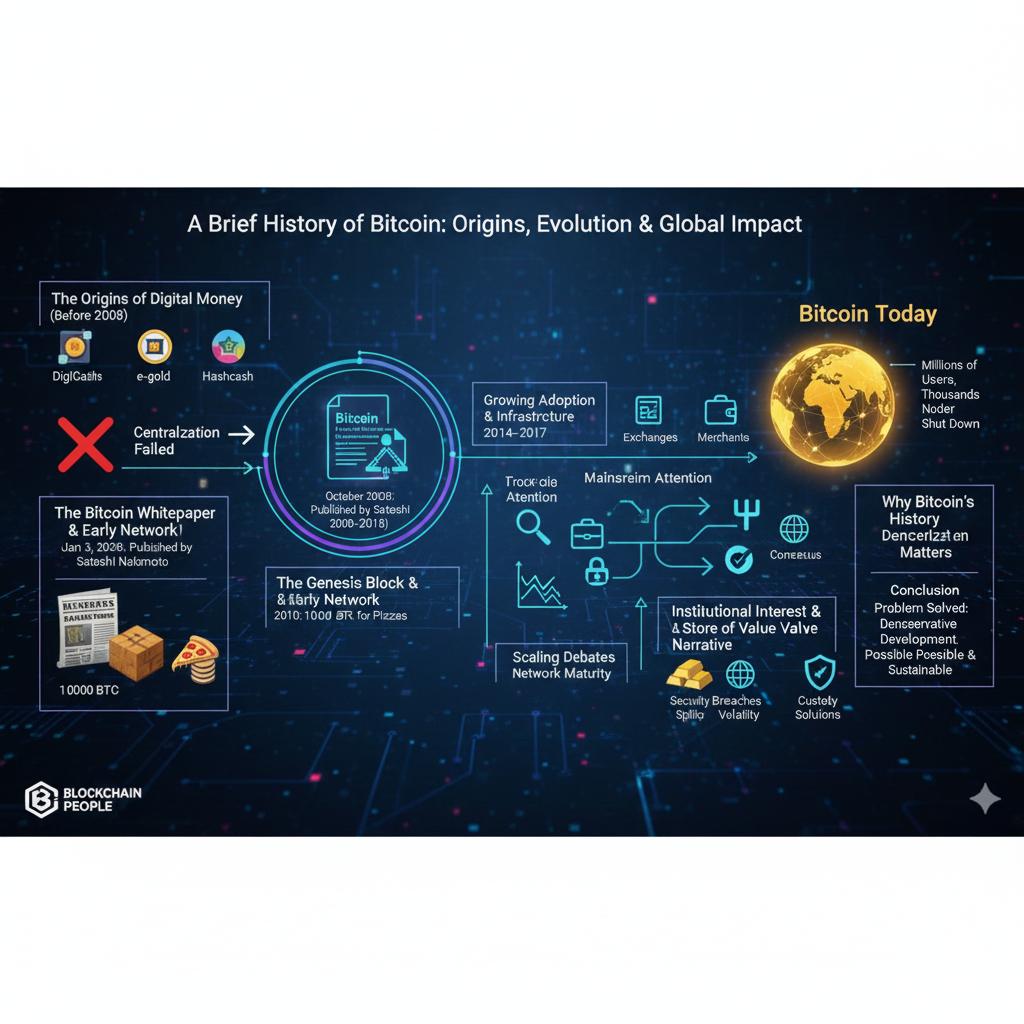
Before Bitcoin, researchers and technologists had long explored digital cash. Projects like DigiCash, e-gold, and Hashcash attempted to create online payment systems that were faster and more private than traditional banking.
Most of these systems failed for the same reason: centralization. They re lied on a trusted company or authority to issue currency, process transactions, or prevent double spending. When those entities shut down, were regulated, or compromised, the systems collapsed.
This unresolved problem—how to create digital money without a central authority—set the stage for Bitcoin.
The Bitcoin Whitepaper (2008)
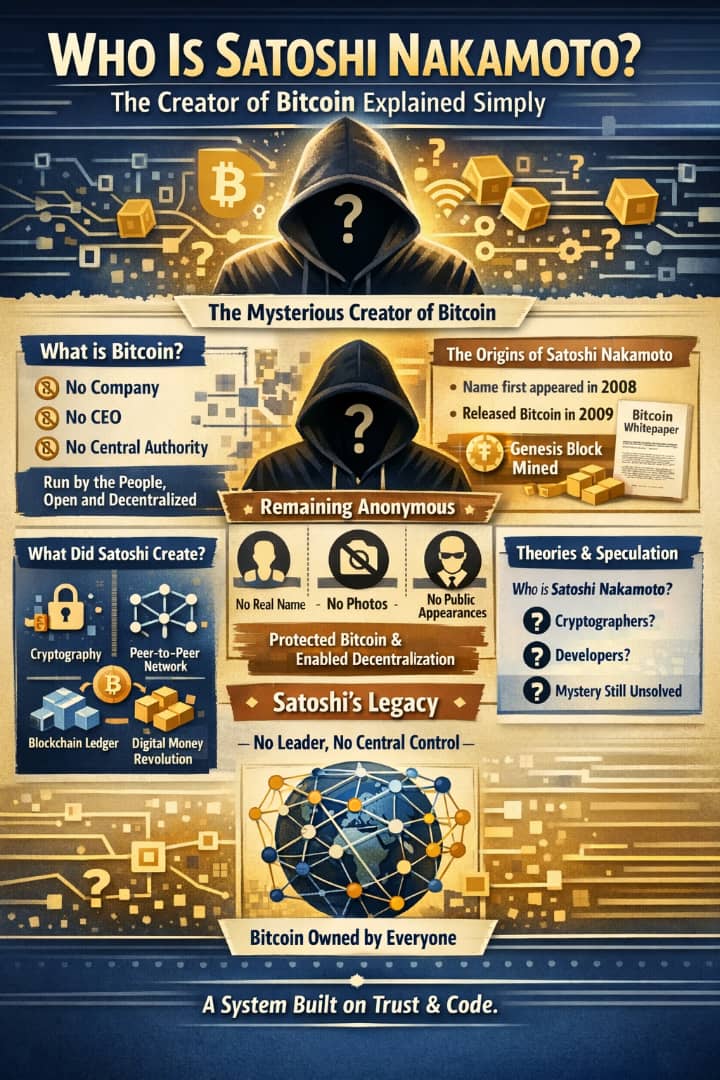
In October 2008, during the global financial crisis, a person or group using the pseudonym Satoshi Nakamoto published a nine-page paper titled “Bitcoin: A Peer-to-Peer Electronic Cash System.”
The whitepaper proposed a radical idea: a decentralized network where participants could transact directly, verify transactions collectively, and maintain a shared ledger without trusting intermediaries.
Bitcoin combined several existing technologies cryptographic hashing, peer-to-peer networking, and game-theoretic incentives into a blockchain consensus mechanism that solved the double-spending problem without central oversight.
This was the breakthrough previous digital cash systems lacked.
The Genesis and Early Network (2009-2010)
Bitcoin officially launched on January 3, 2009, when Satoshi mined the Genesis Block, the first block in the Bitcoin blockchain.
Embedded in the block was a message referencing a newspaper headline about bank bailouts. This was widely interpreted as a commentary on financial centralization and systemic risk.
In its early days, Bitcoin had no market price. It was mined and exchanged by a small group of cryptography enthusiasts who viewed it as an experiment. Transactions were informal, and mining could be done on standard personal computers.
In 2010, Bitcoin gained its first real-world valuation when 10,000 BTC were exchanged for two pizzas, an event that later became symbolic of Bitcoin’s early stage.
Growing Adoption and Infrastructure (2011-2013)
As awareness grew, Bitcoin began attracting developers, users, and early investors. Exchanges emerged to facilitate trading, wallets were developed to store private keys, and online merchants started accepting Bitcoin as payment.
This period also revealed Bitcoin’s growing pains. Security breaches, exchange failures, and price volatility highlighted the risks of an emerging system without established infrastructure or regulation.
Despite these challenges, Bitcoin continued to operate as designed blocks were produced, transactions were validated, and the network remained online without centralized control.
This resilience strengthened confidence in the protocol itself, even as surrounding businesses failed.
Scaling Debate and Network Maturity (2014-2017)
As Bitcoin usage increased, limitations became more visible. Transaction throughput was low, fees rose during periods of congestion, and debates emerged over how the network should scale.
These debates culminated in protocol upgrades and, in some cases, network splits. While controversial, they demonstrated Bitcoin’s governance model in action: changes required broad consensus among participants rather than top-down decisions.
In 2017, Bitcoin reached mainstream attention as its price surged, introducing it to a global audience and intensifying scrutiny from regulators and institutions.
Institutional Interest and Store of Value Narrative (2018-2021)
Following market corrections, Bitcoin entered a new phase. Institutional investors, public companies, and financial firms began exploring Bitcoin as a long-term asset rather than just a payment system.
Bitcoin’s fixed supply of 21 million coins became central to its identity as a potential hedge against inflation and monetary expansion. Custody solutions improved, regulatory clarity increased in some regions, and financial products tied to Bitcoin emerged.
During this period, Bitcoin’s role shifted from experimental currency to digital store of value.
Bitcoin Today
Today, Bitcoin operates as a global, decentralized network with millions of users, thousands of nodes, and a market presence that influences the broader cryptocurrency ecosystem.
It is used for long-term holding, cross-border transfers, censorship-resistant payments, and as a foundation for financial innovation. While debates around scalability, energy use, and regulation continue, Bitcoin remains operationally resilient.
More than a decade after its launch, Bitcoin has never been shut down, altered unilaterally, or controlled by a single entity.
Why Bitcoin History Matters
Bitcoin’s history explains its design trade-offs, conservative development approach, and strong emphasis on decentralization. Every major decision from block size to consensus rules reflects lessons learned from earlier failures in digital money.
Understanding where Bitcoin came from is essential to understanding why it continues to matter in conversations about the future of money.
Conclusion
Bitcoin’s journey from a whitepaper to a global financial phenomenon is a story of technical innovation, ideological conviction, and decentralized coordination. It did not succeed because it was efficient or convenient, but because it solved a problem no one else could.
As digital finance continues to evolve, Bitcoin remains the reference point proof that decentralized money is not only possible, but sustainable.
About The Author