

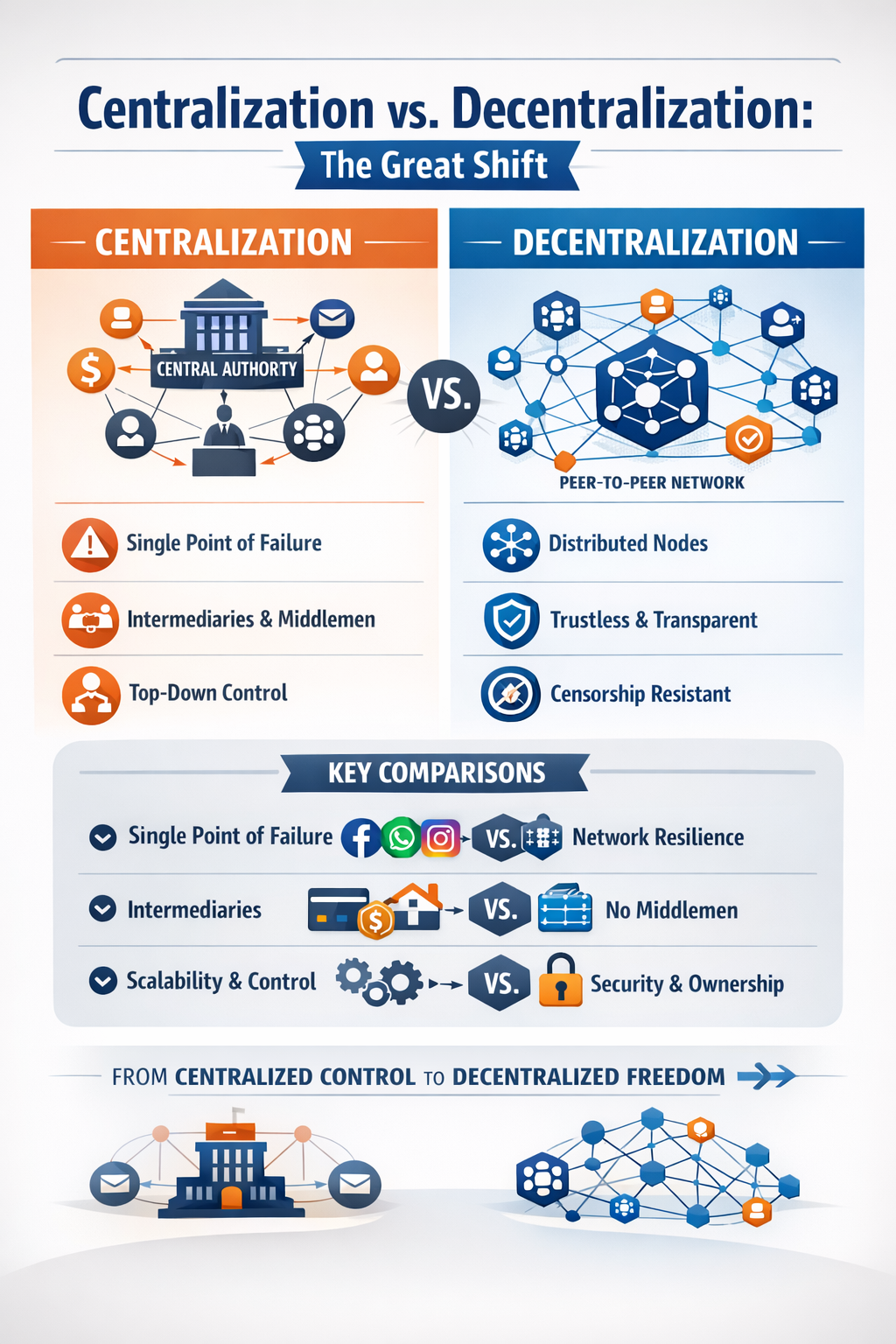
For decades, the digital world has been built around a simple idea: Centralization vs. Decentralization the great shift, even if most people never realized that choice existed. Every post you share, message you send, or transaction you make passes through a centralized authority that stores your data, verifies your identity, and ultimately controls access.
This “hub-and-spoke” model made the internet fast and convenient, but it also made centralization the default. Over time, structural risks quietly accumulated around privacy, security, and ownership. Data breaches became routine. Platform censorship felt normal. Decisions that shaped digital lives happened behind closed doors.
Blockchain technology introduces a fundamentally different approach: decentralization. Instead of trusting institutions by default, trust is distributed across networks, enforced by code, and verified through consensus.
Understanding the shift from centralization vs. decentralization is key to understanding Web3, digital ownership, and the future of global finance (read more in our guide on Understanding Blockchain Technology).
What Is Centralization?
Centralization is a system where control, decision-making, and data are concentrated in the hands of a single entity or a small group.
A traditional bank is a clear example. The bank owns the ledger, verifies identities, and determines whether transactions are approved. Users participate only as customers, not stakeholders (see how traditional systems work in this overview by Investopedia).
Characteristics of Centralization
- Top-Down Control: Decisions are made by executives or governing bodies
- Single Point of Failure: If the central server fails or is compromised, the entire system is affected
- Intermediaries: Users must rely on middlemen to transact or communicate
Centralized systems are efficient and easy to scale. However, they require users to place full trust in institutions to secure data, remain transparent, and act fairly trust that history has repeatedly shown can be fragile.
What Is Decentralization?
Decentralization distributes power across a network instead of concentrating it at the center. In a decentralized blockchain network, no single company or government owns the system. Instead, it is maintained by a global network of independent participants called nodes. Rules are enforced by code, transactions are validated through consensus, and governance is shared among network participants.
Characteristics of Decentralization
- Peer-to-Peer (P2P): Users interact directly without intermediaries
- Trustless Systems: Trust is placed in transparent algorithms, not institutions
- Censorship Resistance: No central authority can unilaterally block users or shut down the network
Decentralization doesn’t remove structure it replaces opaque control with open, verifiable systems (learn more in our article on Blockchain Governance Explained)
Centralization vs. Decentralization: A Direct Comparison
The “Single Point of Failure” Problem
Centralized systems fail from the center outward.
In 2021, a configuration error caused Facebook’s services including WhatsApp and Instagram to go offline globally. One failure at the core disrupted billions of users because everything depended on a single hub (BBC report).
Decentralized networks are designed differently. Even if a significant portion of nodes goes offline, the remaining nodes continue operating. There is no single point that attackers or mistakes can easily exploit. This resilience is one of the most critical advantages of decentralized networks.
The Role of Intermediaries
In centralized systems, intermediaries extract value.
Banks charge transaction fees. Platforms take commissions. Brokers sit between buyers and sellers to enforce trust.
Blockchain replaces intermediaries with verifiable computation.
Transactions are validated by the network itself and recorded on a public ledger. This reduces costs, removes rent-seeking behavior, and enables near-instant global value transfer without permission. Instead of trusting institutions, users rely on math, cryptography, and consensus.
Challenges of Decentralization
Decentralization is powerful but it comes with real trade-offs.
- Scalability: Coordinating thousands of nodes is slower than centralized approval
- User Responsibility: There is no password reset; private key management is critical
- Governance: Network upgrades require broad community agreement, not executive decisions
These challenges are actively being addressed through Layer 2 solutions and protocol upgrades.
Conclusion
The debate around centralization vs. decentralization isn’t about which system is universally better it’s about which model fits the use case. For applications where speed and convenience matter most, some level of centralization may be acceptable. But for money, identity, data ownership, and legal agreements, decentralization offers a powerful alternative: trust without intermediaries.
As the digital world continues to evolve, decentralized systems ensure that control shifts away from institutions and toward individuals. That shift is already underway and blockchain is the infrastructure enabling it.
About The Author


Hey very cool web site!! Man .. Beautiful .. Amazing .. I will bookmark your blog and take the feeds also…I’m happy to find a lot of useful info here in the post, we need work out more strategies in this regard, thanks for sharing. . . . . .