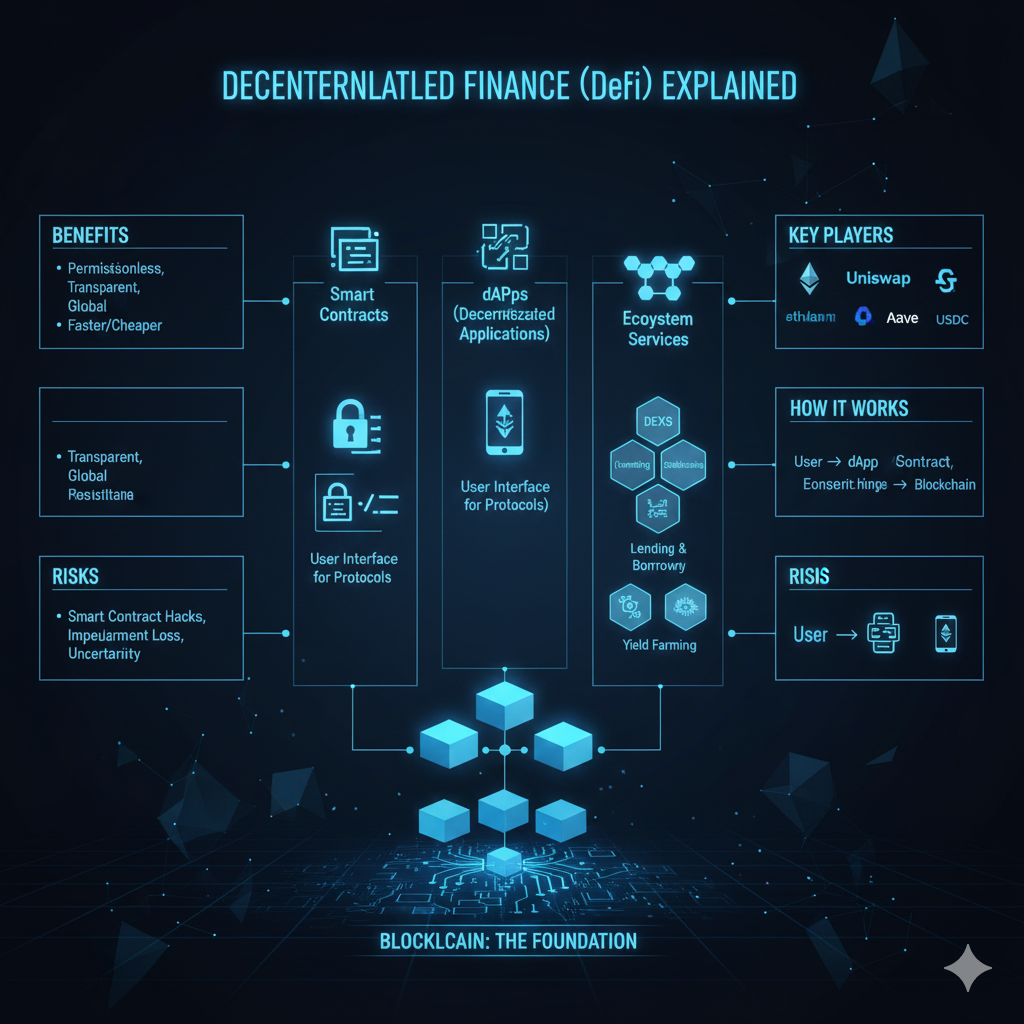
Decentralized Finance (DeFi) is a blockchain-based financial system that allows people to access financial services like crypto lending, borrowing, trading, and yield farming without banks or intermediaries.
By leveraging smart contracts, decentralized applications (dApps), and public blockchains like Ethereum, DeFi makes financial services transparent, permissionless, and accessible globally.
Instead of relying on traditional institutions, DeFi uses smart contracts on public blockchains to enable lending, borrowing, trading, and earning in a secure and automated way.In DeFi, code replaces banks.
How Decentralized Finance (DeFi) Works on Blockchain
DeFi is not a single platform. It is an ecosystem made up of different layers working together. Blockchain as the Foundation of DeFi. The blockchain records and secures all DeFi transactions.
Ethereum is the most widely used blockchain for DeFi, but networks like Solana and Layer 2 solutions offer faster speeds and lower transaction fees.This layer ensures transparency, security, and immutability.
How Smart Contracts Work in Decentralized finance
Smart contracts are self-executing programs stored on the blockchain.They automatically enforce rules.
For example:
✓Deposit crypto as collateral
✓Receive a loan instantly
✓Automatic liquidation if collateral value dropsNo human approval is required.
https://blockchainpeople.nl/what-are-smart-contracts/
Using Decentralized Applications (dApps) in DeFi
DeFi users interact with smart contracts through decentralized applications (dApps).These apps look like normal websites but connect directly to blockchain networks instead of centralized servers.
Key Components of the DeFi Ecosystem for Beginners
The DeFi ecosystem recreates traditional financial services in a decentralized way.
Decentralized Exchanges (DEXs) for Trading Crypto
Decentralized exchanges allow users to trade cryptocurrencies without centralized control. Platforms like Uniswap use Automated Market Makers (AMMs) instead of order books.Users trade against liquidity pools rather than buyers or sellers.
Benefits include:
➢24/7 trading
➢No custodians
➢Full user control
DeFi Lending and Borrowing Platforms
DeFi lending platforms like Aave and Compound allow users to earn interest or borrow crypto. Loans are usually over-collateralized, meaning users deposit more value than they borrow. No credit checks. No identity verification
Stablecoins in Decentralized Finance
Stablecoins like USDC and DAI are essential to DeFi. They maintain a stable value, usually pegged to the US dollar, helping reduce volatility in DeFi transactions.
Advanced DeFi Concepts and Strategies
Yield Farming in DeFi for Higher Returns, yield farming involves moving assets across DeFi protocols to earn returns.
Users may:
▼Provide liquidity
▼Receive LP tokens
▼Stake those tokens for rewards
Returns vary and come with risks.
DeFi Composability: Money Legos Explained
DeFi protocols are open-source, allowing them to connect and build on each other. This flexibility enables complex financial strategies using multiple protocols at once.
Liquid Staking in DeFi
Liquid staking allows users to stake assets while still using them in DeFi. Users receive a derivative token that can be used as collateral in other DeFi applications.
Benefits of Decentralized Finance (DeFi)
DeFi offers advantages over traditional finance:
⪼Permissionless access to financial services
⪼Transparency through public blockchain data
⪼Faster transactions with reduced costs
⪼Global accessibility without banks
Risks of Decentralized finance You Must Know
Despite its benefits, DeFi carries risks.
⪼Smart Contract Vulnerabilities
⪼Coding errors can lead to major losses
⪼Impermanent Loss in DeFi
⪼Liquidity providers may lose value due to price fluctuations.
Regulatory Uncertainty in Decentralized Finance
DeFi regulations differ across regions and continue to evolve.
Self-Custody Risks
Users are fully responsible for their funds and private keys.
The Future of DeFi in 2025 and Beyond
DeFi is evolving beyond experimentation.The rise of Real World Assets (RWAs) is bringing real estate, bonds, and commodities onto the blockchain.This shift could increase adoption and liquidity while introducing stronger regulatory oversight.
DeFi is gradually becoming core financial infrastructure.
Final Thoughts: Is DeFi the Future of Finance?
Decentralized Finance is reshaping how people interact with money.
➢It is open.
➢It is global.
➢And it is still evolving.
Understanding DeFi is becoming essential for anyone exploring blockchain and Web3.
About The Author