

Imagine investing in a building or a loan without ever touching paperwork or lawyers. Now imagine receiving returns directly into your digital wallet. This is the promise of real world asset tokenization. But behind the scenes there is a quiet structure doing the heavy lifting. That structure is the SPV.
If someone with no finance background cannot understand this concept then we have failed. So let us explain it simply.
Special Purpose Vehicle SPV
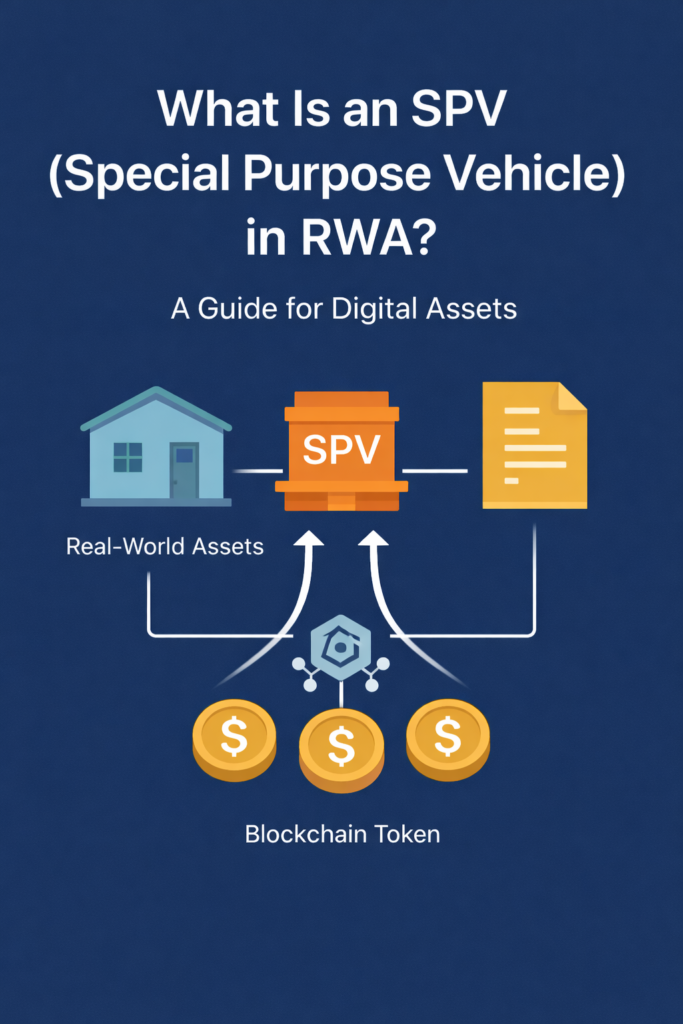
An SPV is a legally created company that exists only to hold one specific asset or group of assets. In real world assets it acts as the legal bridge between physical assets and digital tokens.
What Problem Does an SPV Solve in RWA
Real world assets like property invoices or bonds exist in the physical legal world. Blockchain tokens exist in the digital world. These two worlds do not naturally speak to each other.
The SPV connects them.
It does three important things
1 It legally owns the asset
2 It issues or supports the token that represents the asset
3 It manages money coming in and money going out
Without an SPV most tokenized assets would have no legal backing.
How an SPV Works Step by Step
Step One Asset Isolation
The asset is placed inside the SPV. This protects investors if the parent company fails.
Step Two Token Representation
Tokens are issued to represent economic rights linked to the asset held by the SPV.
Step Three Cash Flow Collection
Income such as rent interest or repayments flows into the SPV.
Step Four Distribution
The SPV distributes returns to token holders based on predefined rules.
This structure creates trust clarity and legal certainty.
Why SPVs Matter for Compliance
Regulators care about ownership responsibility and investor protection.
An SPV helps by
1 Creating a clear legal owner
2 Making audits and reporting easier
3 Supporting compliance with securities and tax laws
Without an SPV regulators may see tokens as unbacked promises.
Why SPVs Matter for Custody
Custody is about control and safety.
An SPV ensures
1 Assets are not mixed with unrelated business risks
2 Legal claims are clear during disputes
3 Institutional investors feel safer entering the market
This is critical for large capital participation.
Case Study SPV Use in Centrifuge
Centrifuge tokenizes real world assets like invoices and credit agreements.
How they use SPVs
1 Each asset pool is backed by legal agreements
2 SPVs hold the underlying claims
3 Tokens represent access to cash flows
4 Returns are distributed through onchain systems
This structure allowed billions in assets to enter decentralized finance while maintaining legal clarity.
It proves that SPVs are not optional. They are foundational.
Multimedia Learning Resource
For a visual explanation of SPVs and asset structures
YouTube search title
What is a Special Purpose Vehicle SPV
Common Misunderstandings About SPVs
1 An SPV is not a scam entity when used correctly
2 It does not remove regulation it supports it
3 It does not reduce transparency it increases it
Most failures come from poor design not from the concept itself.
Key Takeaways
1 SPVs legally connect real world assets to digital tokens
2 They protect investors and simplify compliance
3 They manage cash flow and distribute returns
4 Serious RWA projects always use SPVs
If you skip the SPV you are building on sand.
If this helped you understand SPVs clearly you will also want to read our related post
What Is the Tokenization Trilemma? Balancing Liquidity Compliance and Custody
That article explains why SPVs exist in the first place and how they fit into the bigger system.
Your learning journey continues there.
About The Author
