Cryptocurrency exists only on the blockchain. It is digital by nature. It is not physical cash, and it is not stored in a bank vault or saved on a device like a document or file.
To access and use cryptocurrency, people rely on cryptocurrency wallets.
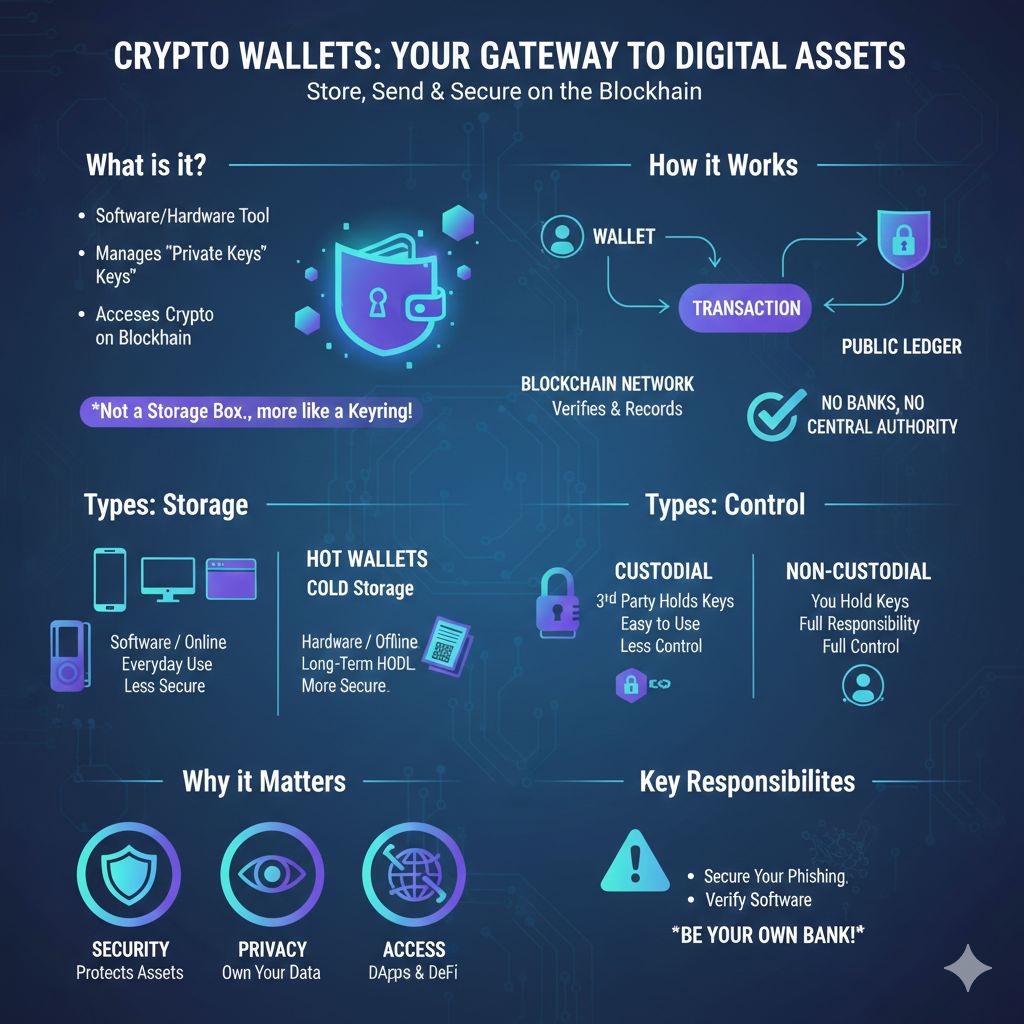
A cryptocurrency wallet is a tool that allows users to interact directly with blockchain networks. It enables them to send, receive, and manage digital assets such as Bitcoin and other cryptocurrencies.
Despite the name, wallets do not actually store cryptocurrency itself. Instead, they store the cryptographic information needed to access funds that exist on the blockchain.
Understanding how wallets work is essential for anyone participating in crypto.
What Is a Cryptocurrency wallet?
A cryptocurrency wallet is software or hardware designed to manage private keys.
Private keys are cryptographic credentials that prove ownership of funds on a blockchain. Whoever controls the private keys has control over the associated assets.
The role of a wallet is to:
Generate and store private keys
Sign transactions securely
Display balances
Enable interaction with blockchain networks
The cryptocurrency itself always remains on the blockchain. The wallet only provides access.
This distinction is critical. Losing access to private keys means losing access to funds, often permanently.
How Cryptocurrency wallets work
When someone sends cryptocurrency, they are not sending coins directly. Instead, they create a transaction that updates the blockchain’s public ledger.
The wallet signs this transaction using the private key. The blockchain network verifies the signature and records the transaction if it follows the protocol rules.
No bank is involved.
No central authority approves the transfer.
The blockchain enforces the rules automatically.
Wallets act as the bridge between users and decentralized networks.
Types of Cryptocurrency wallets
Cryptocurrency wallets generally fall into two broad categories, based on how private keys are stored and managed.
Software Wallets
Software wallets are applications that run on mobile phones, desktop computers, or web browsers.
They are commonly used for:
Everyday transactions
Interacting with decentralized applications
Managing multiple digital assets
Because software wallets are connected to the internet, they offer convenience and accessibility. However, they require strong security habits from users to reduce risks.
Hardware Wallet
Hardware wallets are physical devices specifically built to store private keys offline.
They are often used for:
Long-term storage
Higher-value holdings
Reducing exposure to online attacks
By keeping private keys offline, hardware wallets reduce certain security risks. However, they must be handled carefully, and recovery backups must be stored safely.
Custodial vs Non-custodial Wallets
Another important distinction between wallets is who controls the private keys.
Custodial Wallets
Custodial wallets are managed by third-party service providers, such as cryptocurrency exchanges.
In this model:
The provider controls the private keys
Users access funds through accounts
Recovery options are often handled by the service
Custodial wallets offer convenience and ease of use but reintroduce reliance on intermediaries.
Non-custodial Wallets
Non-custodial wallets give users full control over their private keys.
In this model:
Users are responsible for their own security
No third party can freeze or recover funds
Ownership is direct and verifiable
This approach aligns more closely with the original principles of blockchain technology and decentralization.
Why Cryptocurrency Wallets Matter
Wallets are not just storage tools. They shape how users experience cryptocurrency.
Wallet choice affects:
Security
Privacy
Ease of use
Access to blockchain-based applications
A wallet determines whether users truly own their assets or depend on third parties. It also influences how decentralized a user’s interaction with crypto actually is.
Common Risks and Responsibilities
Using cryptocurrency wallets comes with responsibility.
Common risks include:
Losing private keys or recovery phrases
Falling victim to phishing attacks
Downloading fake or malicious wallet software
Poor device or account security
Unlike traditional banking systems, blockchain networks do not provide automatic recovery. Wallet users must understand and manage these risks carefully.
Wallets and the Broader Blockchain Ecosystem
Wallets connect users to more than simple payments.
They are used to:
Interact with decentralized applications
Participate in on-chain governance
Access blockchain-based financial services
Manage digital identities
As blockchain adoption expands, wallets are increasingly becoming gateways to entire digital ecosystems.
Why Understanding Wallets is Essential
For newcomers, wallets are often the first direct interaction with cryptocurrency.
Misunderstanding how wallets work can lead to costly mistakes that are difficult or impossible to reverse. Understanding wallets builds confidence, improves security awareness, and supports responsible participation in blockchain networks.
This knowledge forms the foundation for more advanced topics such as seed phrases, wallet security practices, and hardware storage solutions.
Conclusion
Cryptocurrency wallets are essential tools for interacting with blockchain networks. They do not store crypto itself, but they control access to digital assets through private keys.
Whether software-based or hardware-based, custodial or non-custodial, wallets determine how users store, send, and manage cryptocurrency.
Understanding wallets is a fundamental step for anyone entering the world of crypto. It marks the shift from observing blockchain technology to actively participating in it.
About The Author