

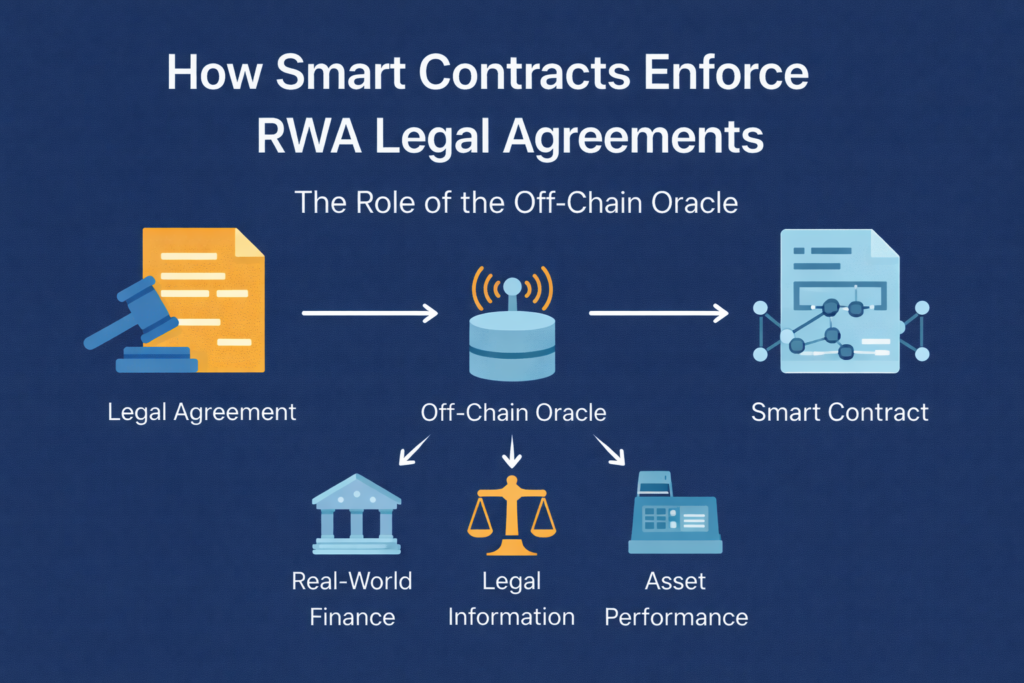
The Role of the Off Chain Oracle
Smart Contract
A smart contract is a self executing digital agreement written in code that automatically follows preset rules.
Off Chain Oracle
An oracle is a trusted data bridge that brings real world information into a blockchain so smart contracts can react to real events.
Introduction
Imagine signing a legal contract that enforces itself without lawyers chasing payments or courts stepping in late. That is the promise of smart contracts in real world asset tokenization.
But blockchains cannot see the real world. They cannot know if rent was paid or if a shipment arrived. This is where off chain oracles become essential.
This guide explains how smart contracts enforce real world legal agreements and why oracles are the missing link that makes everything work.
I Understanding the Problem Smart Contracts Cannot See Reality
Blockchains are closed systems. They only understand what happens inside the network.
A smart contract cannot confirm
• A property tenant paid rent
• A loan borrower defaulted
• An invoice was settled
• A real asset changed ownership
Without outside input smart contracts are blind. Legal agreements live in the real world. Enforcement requires real world facts.
This gap creates the need for off chain oracles.
II What Is an Off Chain Oracle
An off chain oracle is a system that collects real world information verifies it and delivers it to a blockchain in a trusted format.
Oracles act as messengers between
• Legal systems
• Financial systems
• Asset managers
• Blockchains
They translate reality into data that smart contracts can understand.
III How Smart Contracts and Oracles Work Together
Step One Legal Agreement Is Defined
A legal agreement is written off chain.
Examples include
• Loan contracts
• Rental agreements
• Revenue sharing agreements
This document defines conditions such as payment schedules defaults and penalties.
Step Two Logic Is Encoded Into a Smart Contract
The legal rules are translated into code.
Examples include
• If payment is late then apply penalty
• If default occurs then restrict transfers
• If revenue arrives then distribute funds
The smart contract does not guess. It waits.
Step Three Oracle Feeds Verified Data
The oracle monitors approved data sources such as
• Bank payment confirmations
• Accounting systems
• Asset management platforms
• Court filings or registries
Once a condition is met the oracle sends a signal to the blockchain.
Step Four Smart Contract Executes Automatically
When data arrives the smart contract acts instantly.
Actions may include
• Releasing funds
• Locking tokens
• Distributing returns
• Triggering liquidation logic
No human approval is required.
IV Types of Oracles Used in RWA Systems
Financial Oracles
These confirm payments interest rates and balances from banks and payment processors.
Legal Oracles
These confirm court rulings ownership changes or compliance events.
Asset Performance Oracles
These track rental income project milestones or business revenue.
Multi Source Oracles
These combine several data providers to reduce manipulation risk.
V Case Study Centrifuge and Legal Enforcement
Centrifuge is a real world asset platform that tokenizes invoices and receivables.
Here is how enforcement works
• Legal contracts define borrower obligations
• Smart contracts define repayment rules
• Oracles confirm invoice payments from real world systems
• Smart contracts distribute funds to lenders automatically
If payments stop the system reacts without manual intervention.
This structure allows real assets to behave like programmable financial products.
VI Why Oracles Are the Trust Anchor
Oracles are often the weakest and most important component.
A strong oracle must
• Use trusted data sources
• Be auditable
• Prevent single point failure
• Align with legal accountability
Without reliable oracles smart contracts lose their legal meaning.
VII Common Risks and How Platforms Reduce Them
Risk Data Manipulation
Solution
Use multiple data providers and cross verification.
Risk Legal Mismatch
Solution
Align smart contract logic closely with legal documents.
Risk Oracle Failure
Solution
Fallback mechanisms and manual override clauses.
VIII Why This Matters for Investors and Institutions
This system creates
• Faster enforcement
• Lower legal overhead
• Reduced counterparty risk
• Global access to real assets
Smart contracts plus oracles turn trust into software.
Key Takeaways
1 Smart contracts enforce rules but need real world data
2 Off chain oracles connect law finance and blockchain
3 Strong oracle design is critical for RWA success
4 Legal clarity and technical execution must align
Want to go deeper into how real world assets become programmable financial products?
Explore our related guides on SPVs asset tokenization phases and RWA compliance frameworks to build a complete understanding of the ecosystem.
About The Author
